|
Essays |
Return to the Isthmus
After 8 years or more away from the jungle, Bo and I get
the itch again in the winter of 2023 to go. Or maybe I get the itch and Bo nods
in agreement immediately. Something like that. I still had occasional dreams
about Peru and Ecuador. But we choose Panama which is near and still safe
relatively. Ecuador has taken some political turns since we were last there.
Peru is so many more hours on the plane. So, we await the time and it arrives.
My unstamped one-year old passport is pristine, awaiting the warp of humidity. I
had been to Panama 15 years ago. Bo had never been. We used the trusted Canopy
Family guys and girls and they had new locations, new facilities. One in the
east of Panama that is remote.
Our quiet driver awaited us with a sign on the other side
of all the passages and crowds, the funneled airplane air, the meagre snacks.
Wallet, passport, binoculars, camera, big bag in hand: one pats oneself down
repeatedly, making the list. My wife was convinced I would never make it back
with all the essentials or all my limbs. She had come on the Panama tower
journey all those years ago. Like me, she had vague memories after all that
time. She knew we were going more remote this trip. Too remote, really, for her
tastes.
Bo and I have the air-conditioned van to ourselves. We
had left the world of temps in the 50s and arrived in the world of temps in the
80s. And for the rest of the week, the air-conditioned vehicles are the only
place we will commune with air conditioning. All the viewing windows are ours
through and out of town. Our Spanish is patchy and rusty and poorly developed,
never more, really, than embryonic. Our driver smiles and nods focusing on the
traffic and not his bedraggled Americanos. Everyone, anymore, is more social
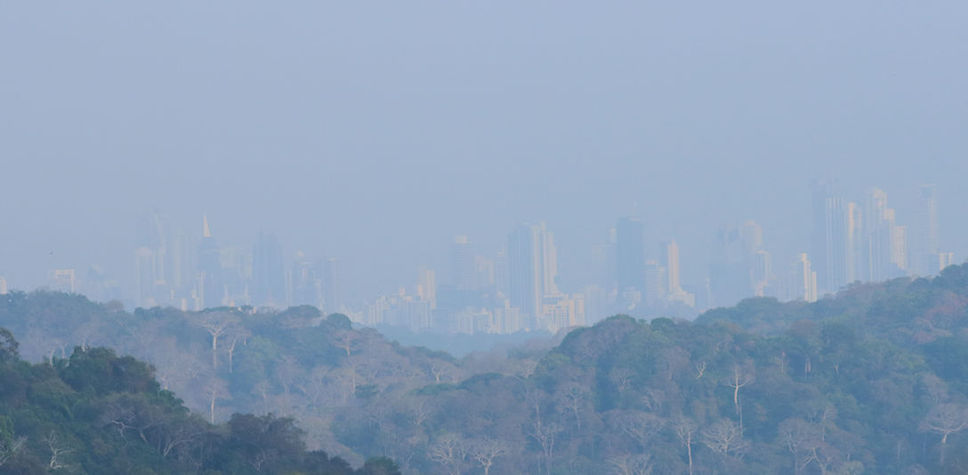
than I am. And the traffic in Panama City is not to be ignored. The roundabouts
and intersections, such as they are, are mostly absent signs or any helpful
guidances. People use their horns, their determined glares, their bumpers to
establish order or the semblance thereof. Auto repair shops, street vendors,
dogs and cyclists, gas prices by the liter: it is all still here. Somewhere in
the big city (almost 500 thousand), Diovelis (and what a lovely name), the one
who had arranged everything for us from afar worked away at a desk.
Since our last journey southward, Bo and I had leaned
towards plants. We do not forget birds, especially down here. But our ears could
detect birds. We even remembered some. And on the information form we had to
fill out about our interests for the guides to better understand us, I had
marked birds, plants, butterflies, and Other. I put a few extra checkmarks next
to Other. Outside the van were already trees in bloom that did not compute. Even
tucked in amongst the Pharmacias and signs for cell phone services, trees were
bearing flowers and fruits that we did not know or remember. It is not that far
from the metropolis to the Canopy Tower, to that curvy road that leads up to it,
to the surrounding Soberania national forest lands. Thirty minutes and it is so
much wilder looking. And the 60-year-old military radar tower had belonged to
Raul Arias de Para for more than thirty years now: the big yellow ball on top,
the encircling array of windows. It looked much the same as my old memory of it.
To the left a deck with zinging hummer feeders. We were given the tour. They now
had fewer water worries and hot water. Everyone had their own bathrooms. There
was an emergency button that our hostess could not ever remember being rung. We
had the Harpy Eagle suite.
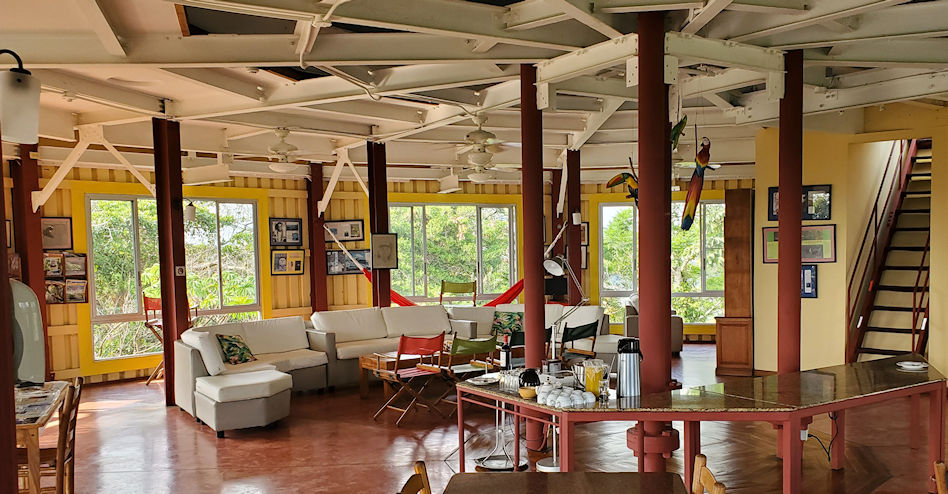
The tower is fully occupied after our arrival. But it does not feel crowded ever. We meet people coming and going, just arriving or on their way out. We meet them mostly at the meals in the common room where all the meals are served. Up the stairways. Four girls from Philadelphia will accompany us over many of the days ahead. Here they have their own guide for now. Di and L, the sisters; Barb and Lor, the friends. They come from a real city with not much surrounding greenery. So perhaps they are hungrier for this world than we are. But Bo and I doubt it. One, L, has real camera gear. The rest with binoculars and phones. We have seen travelers here in the tropics who don’t even bother with binoculars. We are biased. We prefer those with optics. There is a pair, also from Pennsylvania, who are private farmers, the rarest of humans. They are here before the vegetating plants at home erupt and require all their time. They are here to go out on the ocean after bird chasing and get married.
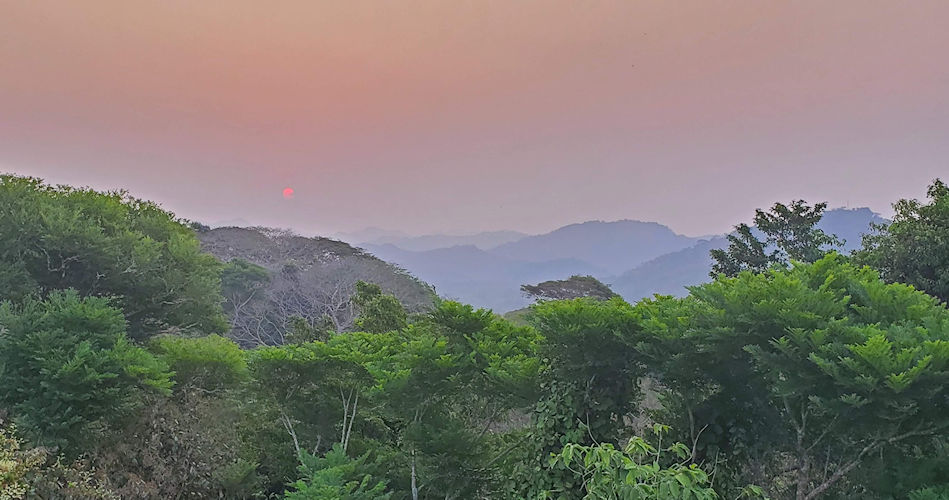
Atop the Canopy Tower again after 15 years more memories seem to seep in. There is a hatch door to the roof which must be opened for access like in some submarine that has freshly surfaced on the ocean top. Supposedly they open it at 5:30 am daily but Bo and I are shuffling around amidst the dark coffee pots at 5:15 and the man who sees us from the kitchen knows that look on our faces. It is the periscope-up face, I guess. We are not rude. Perhaps we pace. But anyway, he marches up the steep stairs and pushes the doorway up for us early. We thank him. Bo and I are the only humans here in the dark. Up and out, the night abounds overhead like a drug for us. Emerging on the circular platform above, the stars glare back. The big rounded top of the former radar tower stands above us as we duck our heads to walk up under the Milky way with coffee. And I see the railings. I see the familiar dual chairs with coffee stand tables between them. They encircle the crown of the tower. It is the height of society to have such a place. I put my hand in a seat and it as wet as after a rain. But it is only the evening moisture accumulating. We flip the seat cushions. It is the best temperature of any time of day here. The lights of the distant cityscape sit southward and muted. Around us, Soberania preserve, forests untouched. We are on the highest hill. And here we wait. We wait for the Howlers. I don’t understand why we are alone. The girls are nowhere nearby. This is not an event that grows old. “Oh, yeah, I’ve heard them.” That does not apply. Bo and I sit, pace, walk, caffeinate. There is no moon. And soon enough the sound begins west and then east and then south. Like a rondo around the compass points. Booming, roaring crescendos in all directions, seemingly answering one another. But frankly I don’t know if that west band can hear the eastern band or the southern band. The great males bawling out the need to be the only ones. “You are not that important. We are the ones.” Echoed by “Liars. Liars. We, the kings, are here not there.” These disparate bands likely never knowing each other beyond the voices in the long night. It is a theme we know as possessive competitive humans. Or perhaps it is our interpretation. It is a rising and crashing sound of dark apes in all directions, circling the tower. Surely a rare place to feel the competitive sounding of the ape spirit from everywhere. Is it reassurance or denial? I don’t know. It is beautiful beyond all boundaries, beyond all definitions of beautiful.
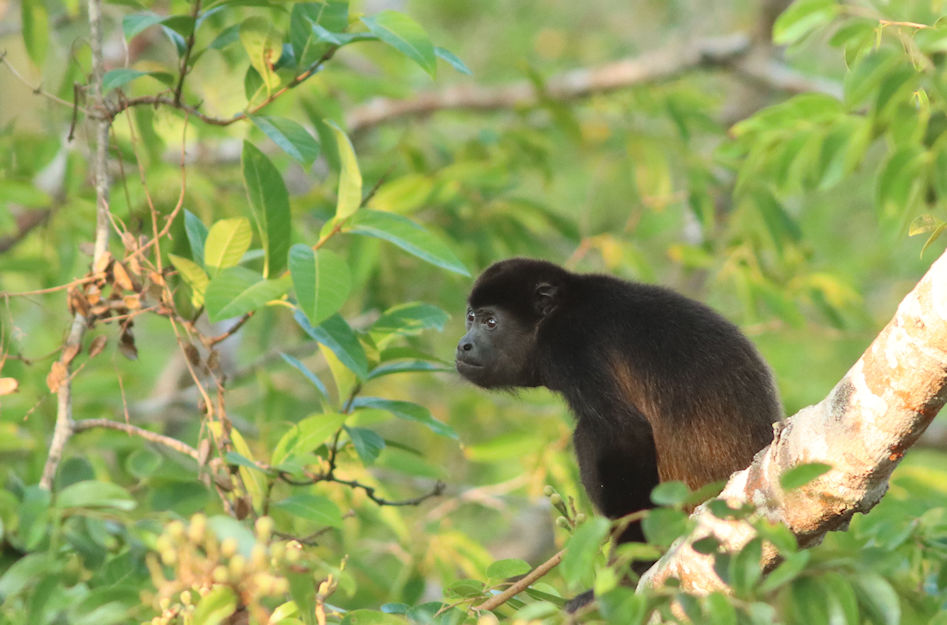
In the closer groups, distinct patterns of crying arise.
It is the singing into the night of the locals. Does one ape decide on the
pattern of wooo wooo hay whoooo that mixes out into everything else. Am I
distinctive, he ponders? Am I something above the norm? One wonders about 10
thousand years ago when the Howlers were truly the ones above all else here in
these particular jungles. When they were the dark rulers in the Gumbo Limbo and
the Cuipo tree towers. Before the white hairless things came. Before the
invaders built their blocks and towers. Before they cut the trees. Before they
cut the beautiful damn trees. They sing and I listen is all I know on these
particular mornings. I want to howl back but I am nothing in the song that
echoes from there and there and there. I am the feeble voice. Just another
listener.
I do remember that in the many audio recordings we sent
out into space on Voyager 1, we supposedly sent a recording of Howler Monkeys
doing exactly this morning singsong. I think it is like 15 billion miles away
now. It is a golden record. It also contains Bach and Mozart and Dark is the
Night by Blind Willie Johnson. And if some dexterous alien civilization figures
out how to scratch a primitive platter into sound then they will surely have
questions. Do I prefer the aliens who swear by the Howlers or by Blind Willie?
It is a distinct separation. Or is it?
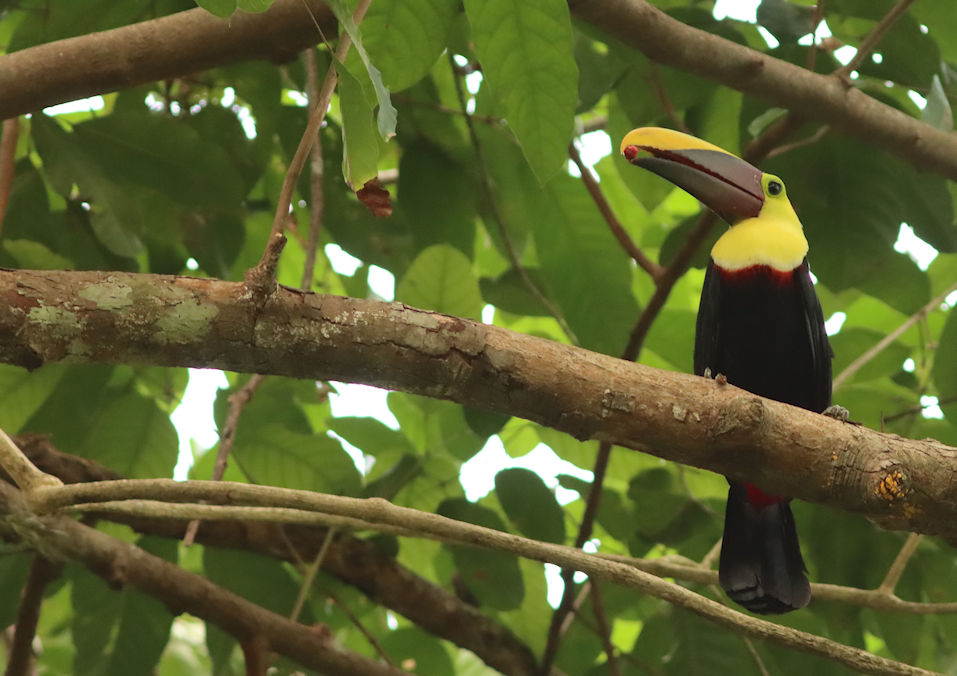
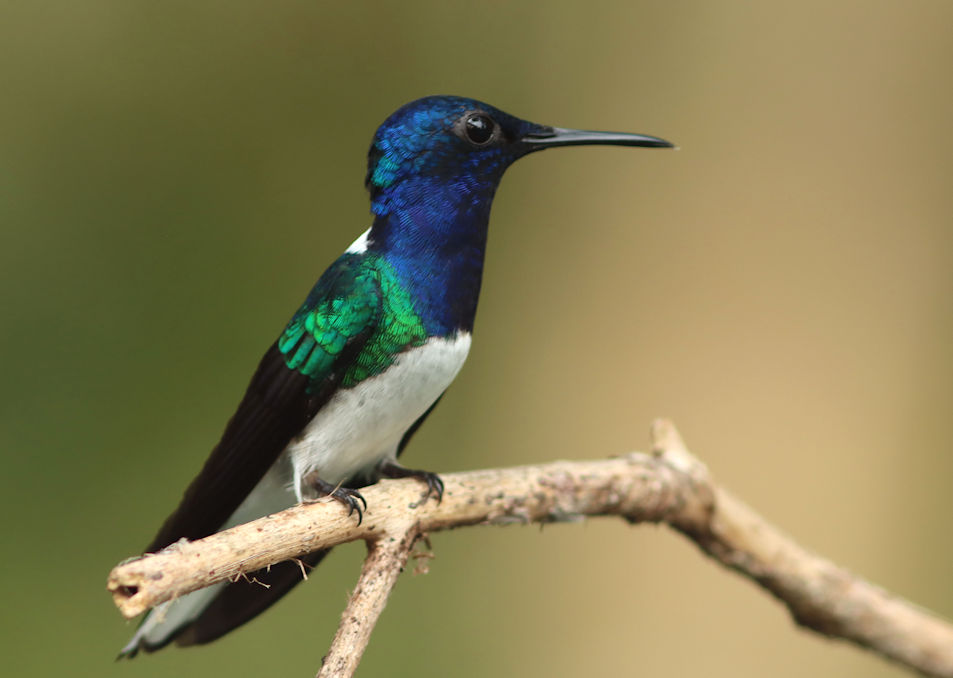
We head for the Pipeline road the next morning. It is a Panamanian destination known I guess around the world. And it is the weekend, so people are walking it. Some seem to be slow driving it all the way. Our van will follow at a distance behind us while Eli takes us up the jungle road. We pass the canal itself where things appear active. Great container ships are edging their way down this busy water passage. Tropical Kingbirds sit the wires. Dragonflies flit. On the road, Eli is immediately attentive to the bird sounds. He and his magic speaker that he hangs on a branch here or there and remotely brings up a song amazes me again and again and often fools me into thinking it is a bird nearby. My repeated quizzical “was that you Eli?” makes him laugh. He just keeps calling in Trogons and wrens. Answering our questions about trees and vines, ants and monkeys. At one point a veritable gang of Song Wrens is right on the trail and Eli’s speaker sets them off into a wild singing reverberation around us. It is one of the great world wren sounds. He pops the scope onto birds in record speeds. The birds often making you gasp at such revelatory closeness in the optics. A trogon in full light looking about three feet away is a striking thing again and again. I don’t know how far we go down that road. But I would go again tomorrow.
On travel day, away from the Tower to the east, we get to
attend to the coffee tower-top dawn event again. It never gets old. And then one
must arrange one’s things for movement. We are swinging by the airport in the
city to grab some more travelers to go with us to the remote Camp site to the
east. And we pick up Anna from France, who is journeying through Panama for a
month after leaving Camp. And we pick up the Colonel and his daughter. The
Colonel is 86 and less than fully mobile. His daughter, who is not really a
birder, is helping dad make his final birding trip after he has travelled the
world for twenty years chasing birds. It is an honorable daughter thing, an
angelwing earning duty she has taken on. The wife remains at home hoping to ever
see the Colonel alive again. They bring along his trusted guide for all those
years, N, who lives in Ecuador. The Colonel paying his guide’s way through all
this, we presume. This fills the van. A separate vehicle packs on the mass of
luggage. We trust the Canopy boys to know what they are doing. And we hit the
highway.
The Pan-American highway on the map, looks like a short
blue line towards Columbia from where we are. In the other direction, it appears
to wind westward and northward through connections in Costa Rica and on to
Nicaragua, Honduras, Guatemala. Unknown roads to me. And the stretch we are
taking on is just a lovely line on the map. It is about 175 miles from Panama
City to the end of the road to the east. I am pleased I did not know that
distance beforehand. The Darien Camp is about 20 miles from the end of the road.
We plan on stopping for a lunch break in a town on the way. I trust the Canopy
guys. They are taking care of us.
Bo sits in the back with L, the second most vocal of the
girls, the one with the camera gear who was in photoshop hell at the tower over
on the couches frequently. She is also the one who forgot her chip reader device
at home. And when the Canopy guys learned of this they sent someone to Panama
City to buy her one. But on the road, I can hear murmurings behind me over the
whole journey wherein these two very different people are exchanging the stories
of their whole lives. They are also riding in the buckboard last seats. We exit
most of the traffic after a detour around an accident. And somewhere soon after
this Eli leans back to tell us that the road ahead is going to get bad soon. And
then, he says, it will get worse. He smiles. And then, he adds quietly, it is
going to get terrible.
I have some concept of terrible roads from travels in north Arkansas. Single track rocky things with occasional trees and large puddles in the way. Roads where you are generally on your own. No real traffic, just rough road and the occasional obstacle. Roads that once they have been travelled you wear like a badge. There is one in Johnson county that Bo and I survived with some dents added to my truck that I am not sure we could ever find again. Nor would we want to without climbing gear and a tank. But this Panamanian highway is supposed to be paved and two lanes, you know, all the way there. But apparently the governing bodies responsible for road maintenance in this one big province of Panama have been, well, lackadaisical for years. One wonders if it was a matter of disinterest in the province to spend money on the road to nowhere (as far as they were concerned.) Or is it a matter of bribery and money going where money should not go. I’m not sure but soon enough Gregorio, our excellent driver, was in the result. And truly at first, it just looked like stretches of difficult gravel, places where pavement was worn away by rain and sun and traffic and governing disinterest. That was the ‘bad’ I suppose. But we rattled on and stopped and started. Then came some true craters and sheer drop offs, lofts into the air. I could hear the occasional groan or suppressed shriek from L and Bo in the back buckboard seats. Dust became the standard visual, the obscuring clouds at ground level. The plantlife was dusted a good fifty yards in either direction from the road. The traffic became a rodeo of avoidance. Sometimes three cars wide and three cars approaching, all looking for the best track in a great dusted game of triple chicken. It wore on one. Though I was too midride for real fear most of the time. There were 18 wheelers and large delivery trucks in the mix. Gregorio seemed to know the stretches by rote and would speed up where the prior knowledge told him: ‘clear for a bit.’ At one point there was a sign with a Biblical quote in Spanish from 2nd Chronicles which included the statement ‘if my people will give up their evil ways, I will restore their land.’ I will repair their roads? I was willing to shed a few of my evil ways for an earlier transition to solid pavement. At the very beginning of the rough stuff, I had wondered why and when the man in charge of all this neglect had not been fired. And later, in the midst of the worst of road, I wondered why he had not been tortured and killed. We broke for lunch at a hummingbird rich café and ate outside. Watching them zing. After lunch we drove down a close river road past a field full of dangling eggplant. Men and women stooped to harvest them. And, wow, I wanted a fresh eggplant just then. The river itself was rocky and trickling. But there were shorebirds and orioles. Butterflies in abundance. A Puffbird did the wolf whistle. We had more road to go after but soon enough we crossed into the province of Darien where the roadmaster must have been worshipped as some sort of God. The girls jumped out for a Darien sign picture and soon after we cruised smoothly into the Camp road.
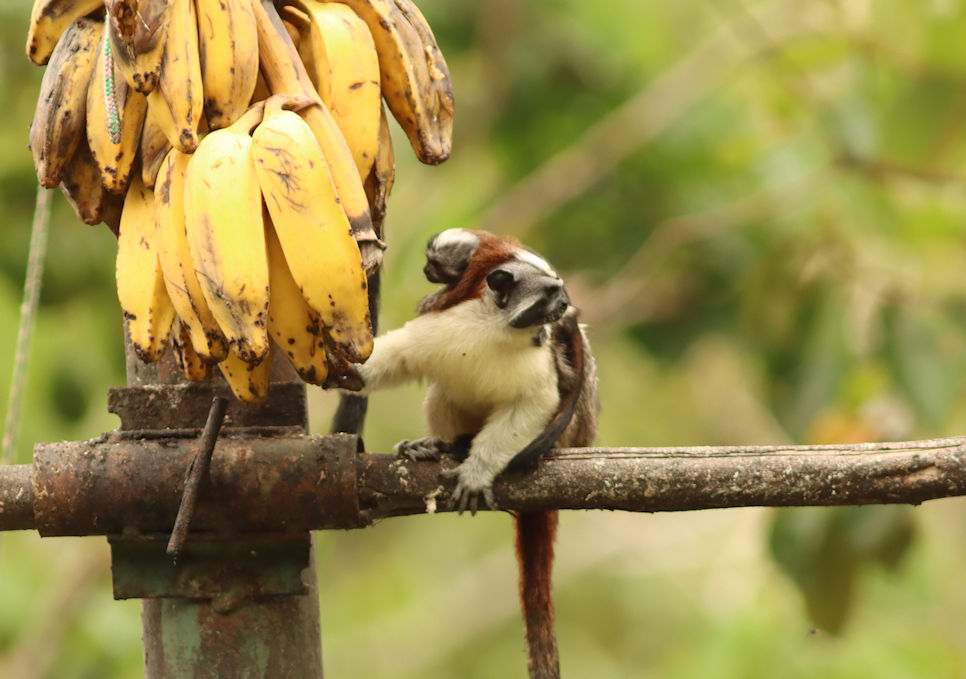
Camp Darien is the newest of the three sites that Raoul
had bought and made into birding and nature preserve destinations. Apparently,
this site in Darien was cattle grazed and poor in plant life when Raoul obtained
it. But it was tucked up the hill near the boundary for a large natural area
that would remain natural. And in the years since it was smoothed into a rolling
hillside of plantlife and fancy tents with comfortable beds and bathrooms, a
patio, a dining area and trails up into the forest. At our arrival, the birdlife
was already rich. And we would be with the lovely small primate called
Geoffrey’s Tamarin for the whole week. Camp kept banana feeders stocked and
hummer feeders aloft. Birds were nesting in the potted plants. The smaller
species of Oropendola the Chestnut-headed, also a beauty, were talking and
eating bananas while we toured and admired the place. After the road rally, it
looked a bit like paradise should.

Bo had brought along his own battery powered blacklight to try and lure some insects out of the nightwoods. But the camp turned out to have a big stable sheet with a roof over it and both black and white lights that they turned on every night at 7 pm. So, despite being fatigued at the end of our days we always ran over to see what the lights have drawn from the trees. And let me tell you, it was usually a melee. The variety of huge Katydids alone was enough to make you wonder about this crazy place. One was rightly called the Giant Katydid. They crawl across the myriad other insects like monster mechanical toys dazzled by the light. These beasts occasionally launched off the light sheet and sought your shoulder or the top of your head. A half-pound insect gets your attention. Many of these insects would sometimes linger there starkly outlined in the daylight the next day and several of the Tamarin monkeys would come down to the buffet and grab a Katydid far bigger than their small hands. One wonders if they could ever find them in the trees or if this was the only time they tasted them. The crunch of the heads in their fine monkey teeth was audible. The Motmots were the only birds we saw fluttering down to the insect array in daylight. We saw no bats. Though I did duck under the low wingbeats of the Greater Potoo one night. It flashed giant in my headlight. Occasionally at night we heard it make its weird growl, its grumbling roar. At home, with my own moth sheet, it only took about three days for the chickadees and titmice to learn that my fluttery empurpled thing was a diner. Moth varieties in the tropics are apparently also endless. Many unknown. We eww’d and ahh’d at them. The Mantises there are dressy and large and come to eat the moths. Holding them like weird sandwiches and dropping the wings in repeated flutters to the ground. There were some insects that would make Bo and I laugh out loud as we could not even say what they were. Other than crazy ass insect. “What the hell is that?” We took their pictures. And tried to sneak off to our beds before something else flew in.
The following day was Harpy Eagle day. Everyone and all
the guides would go in one group. The Harpy being the top winged predator for
all of Central and South America. One showed up in Costa Rica again a few years
ago and made all the news. The bird is and has been declining in Central America
for many years. Eastern Panama being a holdout area for nesting pairs. Which may
number there in the 40 to 60 range. This bird being intolerant of human
encroachment and needing towering trees and good forest to survive. And the
pairs (another mate-for-life bird) only have chicks every 2 to 4 years. The
chicks (always one) after two eggs are deposited require long nest attendance
time up to a year. The nests are located often by the indigenous population in
their controlled wild areas. And because they mean tourism, the locations are
revealed quickly to places like the Canopy Camp. The nest we would be attending
was a three-mile hike into the forest from the river village. Everyone was
offered rental horses for this jungle walk. The Colonel and his daughter
accepted due to his walking difficulties. Though he admitted he had never been
on a horse.
The Harpy is a world bird. An animal known to people that
don’t spend a great deal of their time with binoculars around their necks. Like
the Peregrine Falcon, the Snowy Owl, the Golden and Bald Eagles they seem to be
part of the natural world that is better defined in the minds of even the
hardest of homebound homebodies by books and television, the Natural Geographic
society. But everyone who loves birds knows this big predator, a twenty-pound
killer of monkeys and sloths. It does not soar above the treetops. It stays in
the shadowy understories. And the best way to see them is when they must return
to a nest and care for their young.
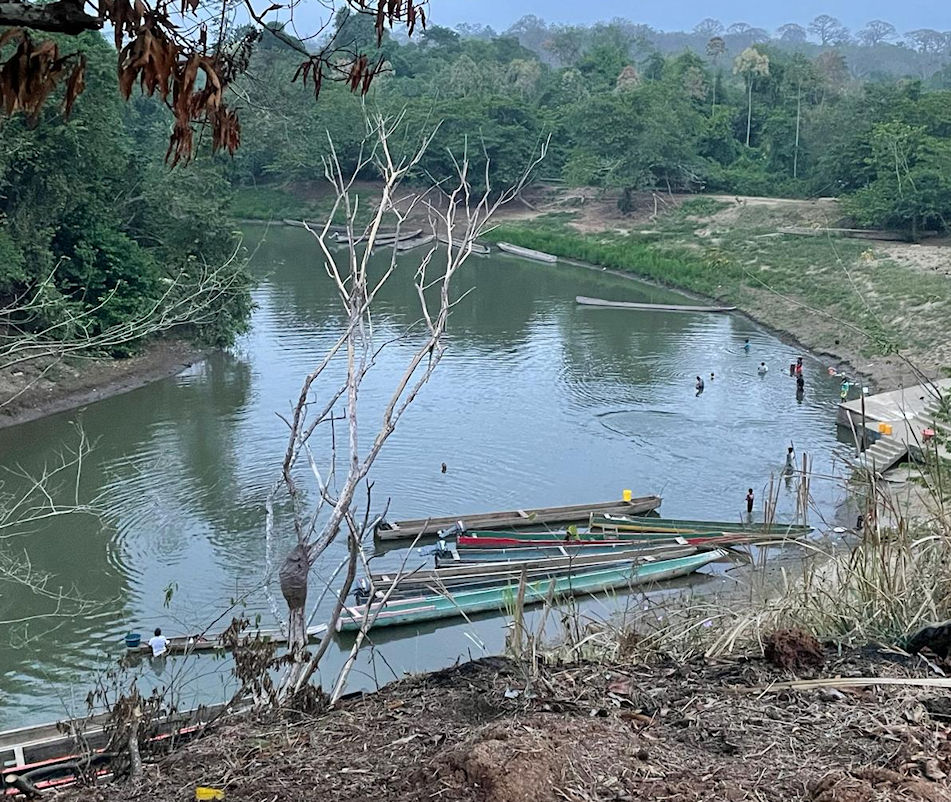
The Harpy trip requires a 4:30 am breakfast and a ride
though the dark to the village where the Emberas villagers will accompany us and
provide horses and horse attendees. We take several vehicles and the road, as
usual, away from the highway is rough and bouncy. I note at 5:20 am along this
road a large lit window with a huge television screen surrounded by 4 or 5
adults. I don’t see what is glaring there. Do they play soccer somewhere at 5
am? Do they get the nature channels here where the rest of us come for nature?
In the village, dawn is suddenly with us. The river looks like a normal river in
this dry season. We cross a bridge that looks like it was made recently from
logs and mud. It looks like it will be good for one rainy season and then will
need replaced. The long handhewn canoes are brightly colored down on the water.
And many villagers are already in the water: bathing, fishing, drifting? It is
not clear. But everything seems peaceful and in order. Eli had told us the day
prior we would be hiking quickly the three miles through the forest to the nest.
A trail had mostly been carved out to the spot. We would stop for something
remarkable but otherwise head down and plow ahead. The horse riders were coming
separately and behind us somewhere.
We walk through the Emberas village. Where everyone astoundingly seems to have two satellite dishes over thatched roofs and windows that are open to whatever the world will bring. Children watch us pass and giggle. Though they see such nature travelers almost everyday parading to the Harpy nest. Chickens and pendulous breasted, recently pregnant dogs seem to be everywhere. Also kittens and chicks. How this balance plays out I do not know. Here and there new hut supports are going up. Concrete blocks lay in wait. The adults mostly ignore us as we straggle eastward out of the limits of this quiet civilization.
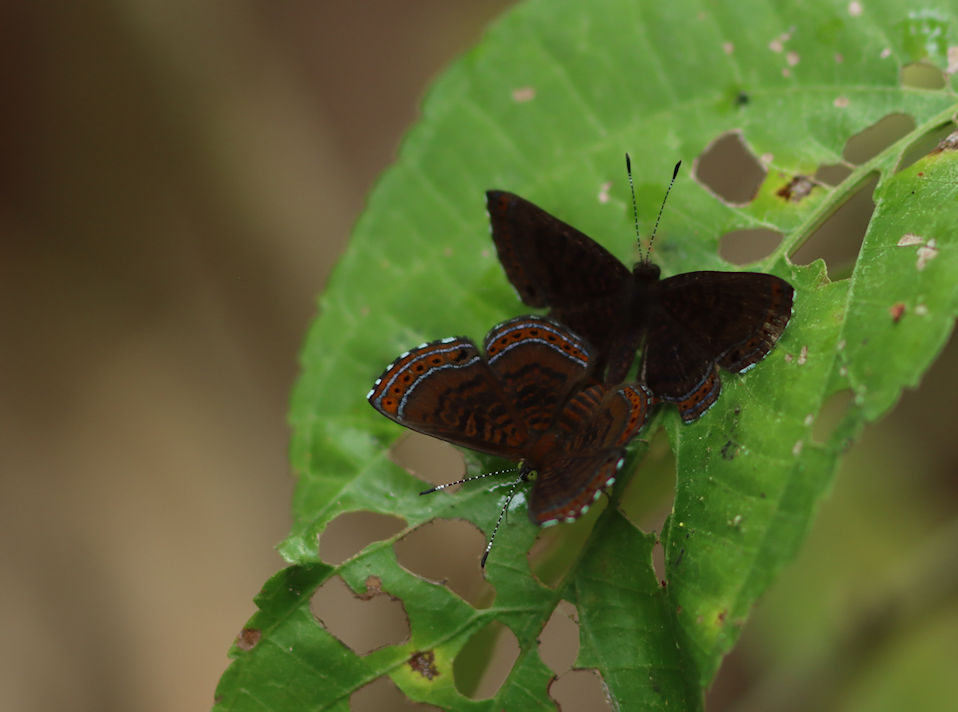
Bo and I being highly distractible, the girls soon plow
ahead. One young machete bearing villager stays with us. It is clear he does not
speak much English, but he pays attention to us. And soon he is stopping and
pointing into the forest at butterflies we have not seen. He smiles and curves
his blade towards a bee or a grasshopper. We thank him every time. Approaching
the destination, the forest gets taller and denser. Everyone begins to talk in
whispers. The trail forks and we find one fork ends east of the nest tree and
one wraps around and ends northeast of the tree. The east end has a treehouse
and benches for viewing comfort. And in the nest which is about 60 or 70 feet up
in a Cuipo tree, one can immediately see a Harpy Eagle. One that is 3 months old
according to Eli. The adults have a mantle of gray and dark feathers wreathing
their great heads. This astonishing juvenile is almost a pure white about the
head dressings. Amidst this is a very large dark beak and some penetrating dark
eyes. It is easy to marvel at such an animal. We all do, marvel, I mean. And
from its prominence, the bird ignores us most of the time. Occasionally it seems
to gaze down upon the weird melee of humans. Surely little understanding that
these grounded things are the most dangerous predators in the world. The bird
gazes mostly eastward as though that is the last place the mother eagle went and
thus where she would return from.
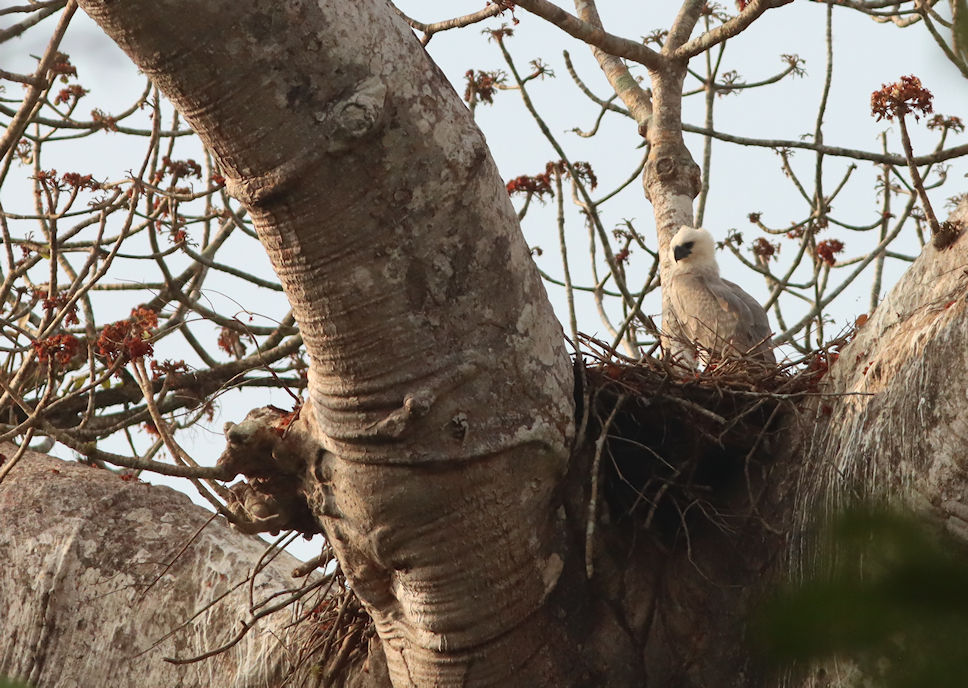
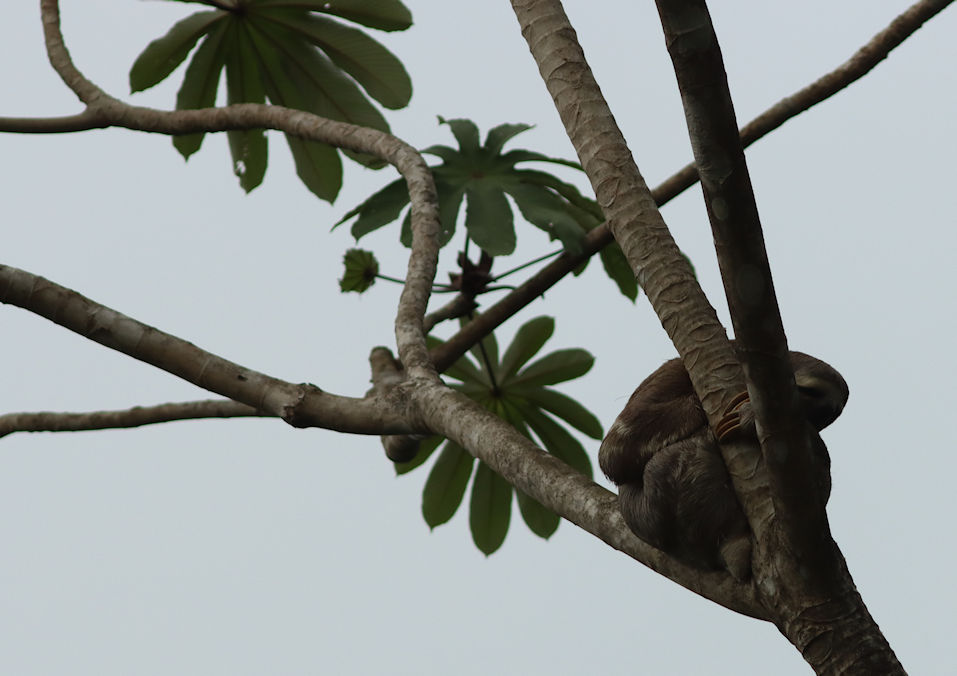
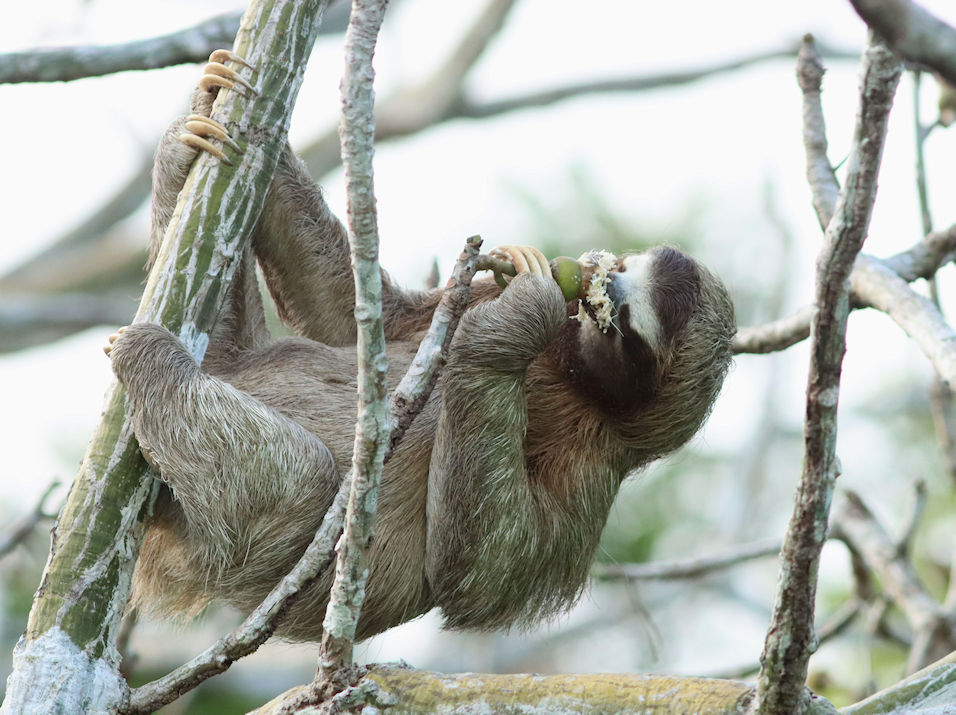
Our caretakers have brought a bounty of drinks and various sandwiches for our sojourn in the forest. For we are there to await the arrival of one of the parent birds. They both hunt to feed this big child. Which sometimes takes many hours. I imagine staring into shaded forest waiting for aa sloth to move. The number of sloths I have seen moving compared to the number I have seen coiled up into sleeping balls is pretty minor. Luckily, while we wait, we are in a beautiful jungle. Morphos bounce around us. A trunk of the impressive Cuipo stands near the east trail end. I put my hands on it, expecting some inherent surge like a powerline buzz. I try it several times. In fact, I touch every Cuipo I come near our whole time in Panama. To climb one would take some doing. And no one dares go up anywhere near a Harpy nest. They are one of the birds that could actually kill an adult human and are highly protective of their youngsters.

We are free to wander quietly in the woods. The horses
arrive and deposit the Colonel safely with us. He has not fallen on the up and
down ride through dry creekbeds and roots. Four Embaras watchers had assured
this, circling him in a protective gang. And his daughter S, on her own horse no
doubt gritted her teeth and palpitated through the whole journey. I wonder, if I
make it to 86 if I would dare such a ride. Most of our Camp group keeps a
vigilant eye on the nest high above. The village minders take naps with their
hats over their eyes. The forest is quiet except for our own murmurings and the
occasional cry of a bird. We examine the plantlife including some intense
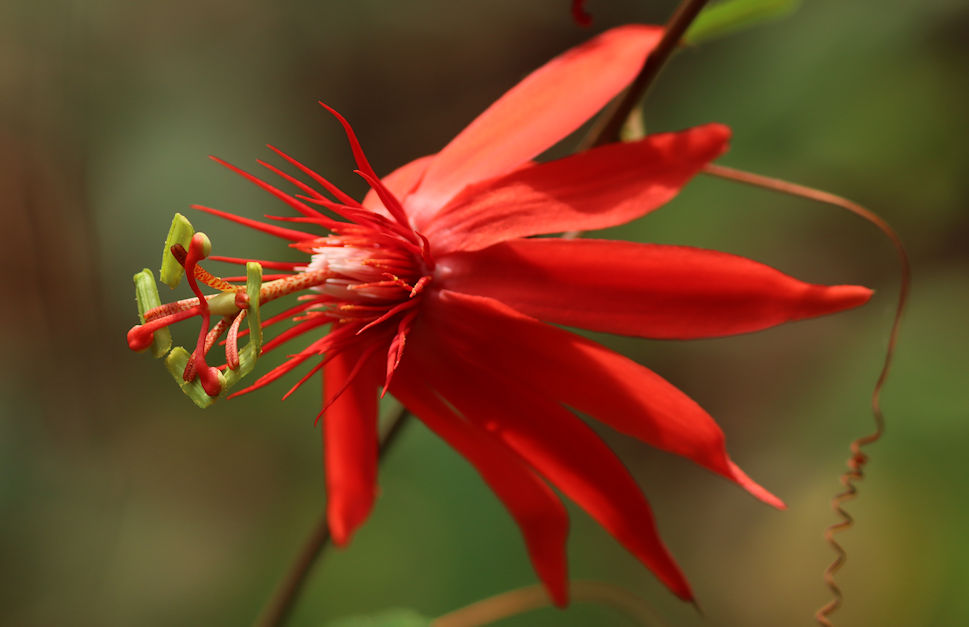
crimson colored passionflowers in bloom. Time passes. We hear some Red-throated
Caracaras and we go find them. Ants parade. The motmots distantly talk among
themselves. The cracker butterflies entertain us on the tree trunks. And then
finally someone yells, “there she is.”
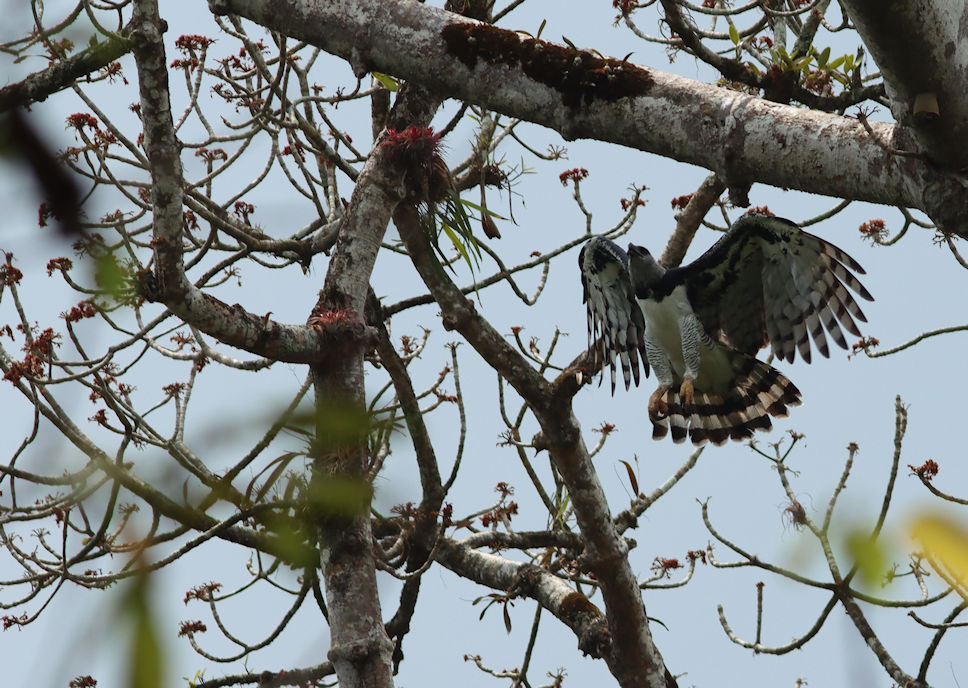
And something fast comes in from the east. It is
obstructed for us northeasters for a moment and then the adult pops up. Eli
informs everyone it is the male, the father. So, there ‘he’ is. He has brought a
medium sized sloth and dropped it in the nest. And now he stands off on the
branches nearby and gazes back at the chick. He is silent. And these things have
an intense gaze whichever direction they fling it. He flies overhead to a tree
nearby and stares off southeast. Junior left to his own sloth devices. And then
dad is gone. Apparently, the mother, when she brings food, attends to some
tearing and preparing of the meat. She presents small portions like someone
cutting your steak up for you. The father does not bother with this skill. And
the chick at the great age of three months does not know what the key to sloth
eating is. Where the sloth zipper is located. He does not know how to make the
bloody seam. Does not know how to get the red sloth heart that he vaguely
remembers. Where are the sloth sweetmeats and how do you get them? We watch him
cry for assistance. Cry for his mother. A repetitive sharp yen. And he does
bounce down and rip some hair from the sloth. Flicks it into the wind. Cries
some more at the sad taste of lichen encrusted fuzz. And we all watch for the
mother to come to such melancholy soundings. But over and hour and a half she is
busy, she has her own hunting to do. And for nine more months the chick will be
dependent on both mother and father. Will learn how to move about the tree,
unfurling those great wide wings. Will learn how to unlock the belly of a monkey
on its own. The Colonel at age 86 can’t believe he has seen a Harpy Eagle. Two
of them, in fact. He says it out loud, “I can’t believe I’ve seen a Harpy
Eagle.” And his daughter, S, is nearly in tears, very emotional. She tries to
get a hug from L. She deserves a hug from everyone. And she knows she has to get
her astonished father back up on a horse and ride three looping up-and-down hot
miles back to the river. We all are aware. He will clutch his saddlehorn like it
is the answer to all the riddles of the world. So he can see his wife again in
the Carolinas and he can brag to his high ranking retiree buddies that he saw
the raptor we all want to be and he came back changed. I hand it to him. I won’t
soon myself forget the Harpy Eagles.
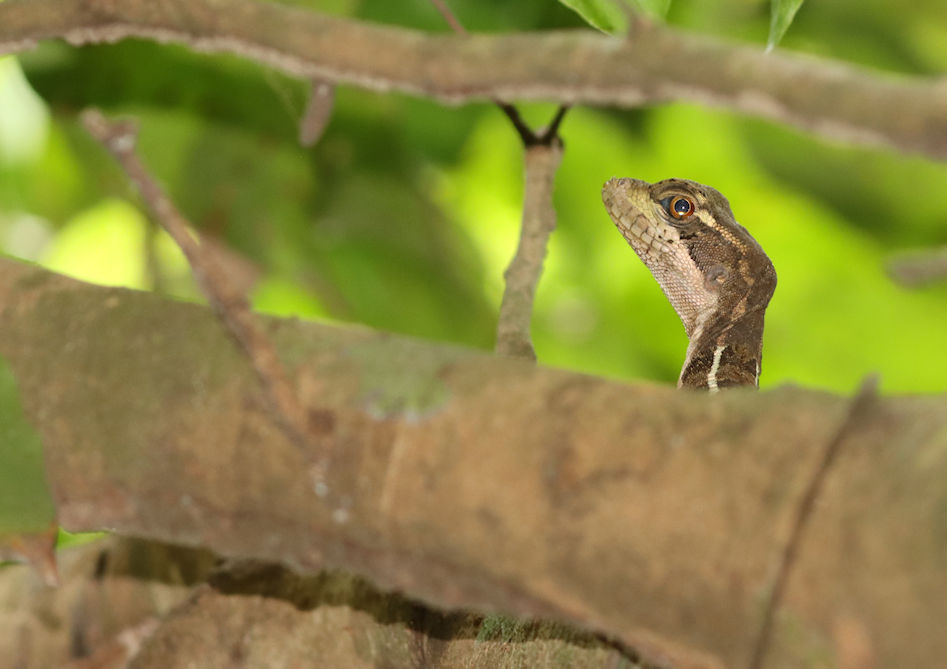
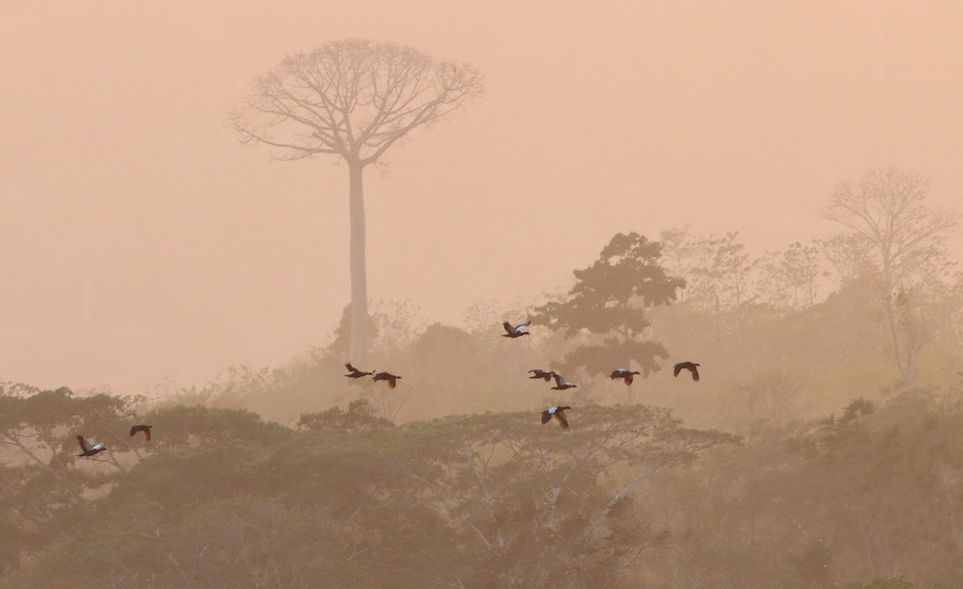
We take another slow dusty road down towards another river village. All these twisted rivers, all these small habitations. A villager awaits us at a cut trail with the ubiquitous machete. There must be an excellent machete shop somewhere down this rough highway: Machetes and Donuts, Machetes R Us. Eli greets the happy villager. Apparently, he and his friends are the ones who cut and maintain this trail which we are told will take us to a lake in a mile or so. On the map later it appears to be an Oxbow lake from the river nearby whose name is the Rio Tuquesa. A twisted thing that must roar in the wet season. We weave through shaded woods and across some floral openings. Bo and I as usual are watchful and distracted by insects. Our heads turning quickly here and there. We even have L shooting some butterflies with her camera. She looks guilty about it. The other girls no doubt thinking we have turned her to the dark side: fleawatchers. We have tainted her pure birdsoul. As we approach the lake Eli asks that we try to be quiet because the Agami Herons are shy. There is at least one here somewhere. And we step carefully into the hidden world of this water zone. Permanent water modifying the mix of denizens anywhere in the world I suppose. Basilisk Lizards bask and stare. We see movement in the water and a Tropical River Otter stops to ogle us. They have almost a smile, showing us the canine teeth. This is a biggish otter. Ignores us afterward. The Agami Heron flushes and perches in a tree and also ogles us. We all look back at it. And D, who has never seen one, looks over at me and says, ‘this is an animal that should not exist in this world.’ It is a rainbow stabbing wonder bird for sure. It makes the Rufescent Tiger Herons, also here, look middling and poorly constructed, badly painted. The beak on the Agami alone makes one shake your head. It seems excessively dangerous. Shy until they pierce you from sternum to spine. Though I am imagining this level of antipathy. I dream sometimes all the animals and birds would love to remove us from this planet. Go back to before automobiles, before rifles, before Mayans, before the isthmus closed and all those northern things crept down upon their quiet place. Like we still are. When will be stop coming?
On an afternoon run after another excellent lunch, Eli
takes us down the Pan-American highway to its end. We are only 20 miles or so of
good road from there. It is Bo and I and the girls and Gregorio, our excellent
driver, along with Eli. We stop and start on the road but there are not many
easy pull-offs. Eli is always watching. The town itself has a population of
about 5000. It is completely rural and down the rough highway far from Panama
city. I imagine most of the city dwellers never venture here. We pull in and
park next to the roadway and it is bustling for such a place. We are about fifty
miles from Columbia. But there are no roads hereafter. The river Tuira zig zags
down towards neverland. Google maps shows some small villages out there. But it
must be wild hike from Columbia to this town at the end of the road. Apparently
in the wet season the riverways are highways for the Panamanian canoeists to
move immigrants from Columbia on their way northward. Panama has tolerance for
and even assists the immigrants on their way. As does Costa Rica, the next
landscape in line. Eli says now they are mostly Venezuelans from the political
disaster and economic wasteland that is presently Venezuela. The town is busy
with pedestrians, shoppers, salesmen and bicycles. Carib Grackles, an
essentially Columbian bird that we will see nowhere else, work the suburban
trees. Otherwise it seems much more urban than 5000 locals would suggest.
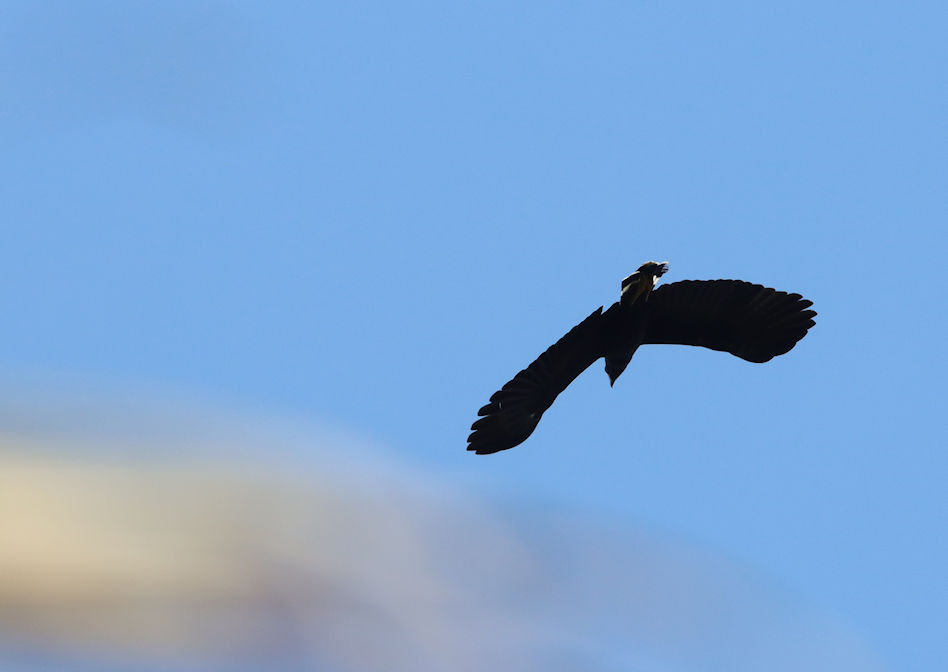
Standing amidst the bustle, we look up at the usual
streaming vultures and watch for other migrants. One of the girls says ‘wow’ and
asks us all to focus our binoculars deeper into the sky and all of us do and we
all make some kind of reactionary noise. Because the density of raptors and
vultures beyond the lowest layers is truly astounding. We had been seeing flocks
of Swainson’s Hawks and Broad-winged Hawks over all the days we had been here.
One morning Swainson’s were perched in the trees out in the field on the road
out of camp. 50 to 100 waiting to lift and roll again after overnighting there.
And one looks for other hawkish, kitish movers in this migratory funnel but you
quickly learn to recognize these dominant migrants from among the innumerable
Turkey Vultures and Black Vultures. The sky here is streaming with hawks. They
are making long riverine connections from one giant vornado of uplift to the
next. We look left and westward and one of those spiraling masses is building as
we watch. I estimate in that one stack alone 5000 birds. We can see another
uplift further to the west. How many towers of warm air stack up all the way to
the United States, to my nesting ground in north Arkansas, in high elevation
Colorado?
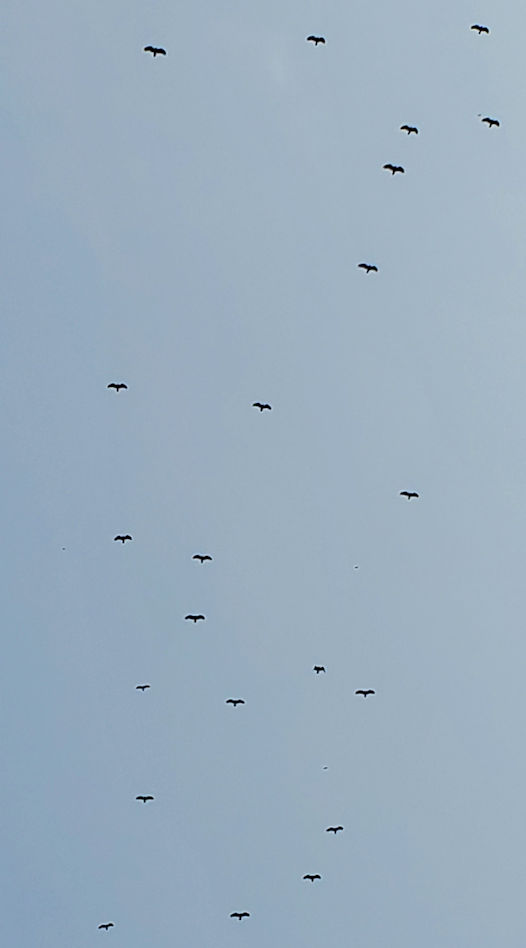
Swainson’s are the western US flock migrant that all go
to the southern Argentinian plains for winter. Every single bird goes to
Argentina. And that concentrated area is the best place to estimate their
number. The recent estimates for them have been about 800 thousand or so. It is
a bird that skirts the western edge of Arkansas but are not common in the
central or eastern parts of my state. The Broad-winged Hawks are our Arkansas
locals that whistle-in every April to nest in the Ozark valleys and around my
home woods. I’ve seen flocks of a hundred or more moving into the state and
northward. They nest across all of the eastern US where it is wooded. They are
forest birds. But I have seen them taking Robins off the lawns in suburbia. Some
of the Broad-wings winter in coastal Mexico and in Central America itself. But
the vast majority of this medium sized raptor winter in northern South America
and they must also pass over this eastern wing of Panama. Their population
estimates are in the 1.8 million range. So, let’s say 1 million of them must
pass across Panama. All of them now in this several weeks in March. In addition,
the huge numbers of vultures are heading back. Not all these migrate but many
do. Also: Mississippi Kites, Plumbeous Kites, Swallow-tailed Kites. Our
Mississippi Kites which also winter all in southern Brazil and northern
Argentina number about 700 thousand. We had seen some few flocks here of that
kite. They may move at lower elevations and feed sometimes and not higher in the
big swirling masses. They are our silvery swooping dragonfly eaters at home.
You’d think the kites would hit a few dragon snacks on the way north. It appears
that Swainson’s and Broad-wings, other than night roosting, just go
hell-for-leather northward, damn the appetite.
The thing about Panama is that it is mostly flattened and
it is narrow. Other than that big drop down wattle in the western portion the
country is 35 to 90 miles wide. There is a ridge of elevation on the Atlantic
side in the east that runs the coast and then a flat zone in the middle of the
eastern isthmus where the Pan-American highway runs. There is one towering
Volcano on the west side of Panama almost in Costa Rica which we must assume
these birds all try and avoid. It lifts up into the thin cold air. And in the
west, it splits there, so that if one were a flying thing you would have to
choose to go left or right. Perhaps the Swainson’s choose left and the
Broad-wings choose right but somehow I doubt if it is that clean or orderly.
More likely it is ‘where is everybody else going?’ Storms or wind perhaps have
some play in the decision. The first-time youngsters coming back from Argentina
are watching the streams of other hawks, choosing. What do they know of
landscape markers or star patterns? Though I would think that the first-time
youngsters would be asking ‘why the hell did we come down here in the first
place?’ And does the decision the first time stay forever. Are there northern
coast hawks and southern coast hawks? Lefties and righties at the Panama split?
Watching them at the end of the road, surrounded by the
bustle of humans who do not care about 50 thousand hawks above them was a new
experience. And we could see the hawks entered the rising thermal column of
swirling bird madness and then rode up as high as the warm lift would take them.
Then they would drop out, bending the wings slightly, and ride downhill to the
bottom of the next elevator. Coasting, never flapping. Spending energy only on
breathing and heartbeats. At two or three thousand feet these hawks could see
both oceans. Oh, to shear the sky above Panama in such a view.

Eli takes us down another back road off the highway. He
seems to have a pocketful of them. It is just the three of us now. The girls are
gone. Road winds up a hill past a huge abandoned house. Someone with money built
this thing out in the nowhere, five hours down the road from hell. And then
died? Had second thoughts? Missed the benefits of city life? It towers white on
a hill as we drive down and northward. We emerge onto a huge open plain. Long
horizons are rare out here. It is a vast rice field in the wet season, Eli tells
us. Now it is a rutted flatland. Off to the east Egrets dance and search for
grasshoppers and tropical dryland insects that I, no doubt, cannot name. No
frogs abide here for now. It is a place of raptors and their searches. And,
indeed, it is chock full of Caracaras. Both Crested and Yellow-headed. I am not
familiar enough with their dietary discretions to guess what has attracted them.
But surely rodents live anywhere this kind of landscape appears. The
Yellow-heads look annoyed at our intrusion. And the Brahma-like cattle are here,
unleashed on the sheared plant stalks, amid the dry season weeds. We flush up
one Yellow-head and he flies low and steadily over and lands on the brow of a
cow. A cow who looks completely unperturbed. Like this is a daily event. Birds
above the eyebrows. Talons on the frontal bossing. We laugh and watch the
Caracara adjust its position.
While we lean and jar ourselves across the creviced
rumble at very low speeds a bicyclist overtakes us. He waves and bounces harshly
away towards the horizon. His destination is a complete mystery. “Today, I will
disappear into the far forest.” He is focused. We work our way up a slope and
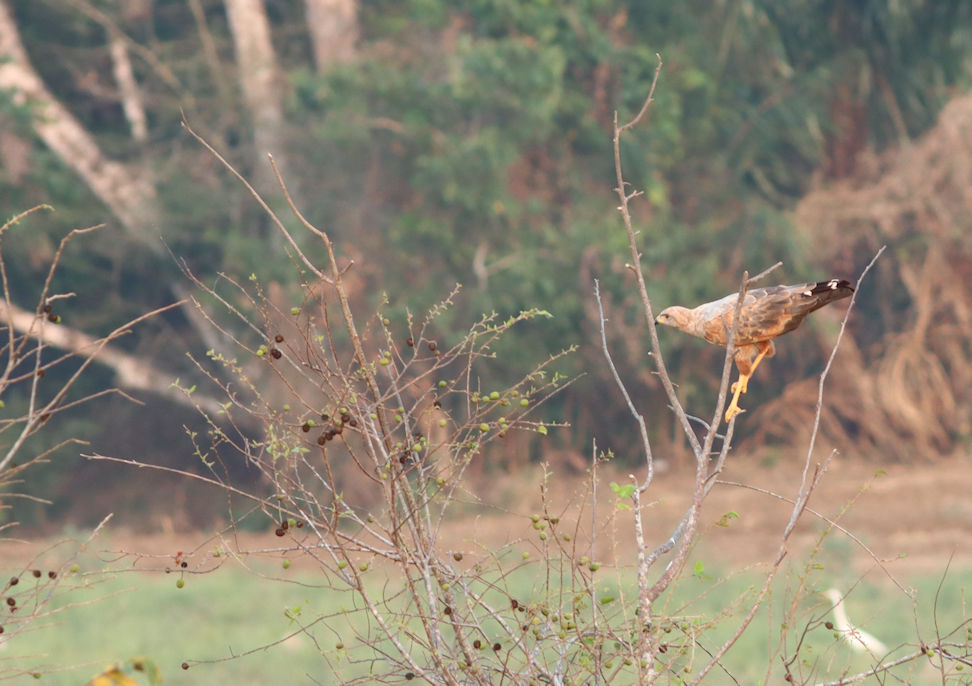
end up atop a hummock in the midst of the great field. A Savannah Hawk soars up
and lands, further defining our surrounding ricefield savannah. He cocks tail-up
in the low breeze showing us his burnished shoulders, his discerning eye. This
elevation must be an island in the wet season, inaccessible except perhaps by
boat or canoe. The sun is sinking in oranges and peach tones westerly. And we
watch a flock of something coming in from the southeast. None of us can define
it initially, in its lazy dark bird shapes and it is a wedge of large birds. Eli
finally says, “ahh, wild Muscovy Ducks.” And indeed, the big pale wing patches
make sense. There are 21 of them. 19 more than I had ever seen before. At home
they live at golf courses and park ponds, here they breed wild on this river
winding west of us. In a land where surely, Caiman eat a large percentage of
helpless ducklings. We saw one shallow mudflat down a cattle road, where D
counted 27 sets of Caiman eyes in a puddle no longer than 50 yards. “They must
be eating each other,” I said. And D laughed. More power to the wild Muscovy. We
shake our heads and make our way back down towards Camp.
After a long morning romp and a chance to relax back in
the camp chairs for a bit, Eli comes running up and he is actually sweating. I
had never seen Eli break a sweat. His tent/cabin is the one at the bottom of the
slow rise we are all on. He says that a King has shown up at the bait station.
“Do we want to go?” Bo and I grab the cameras and down the hill we go. The Camp
guys buy cow heads and pig heads from the locals after they slaughter the
animals for their own meaty needs. A commerce I am sure they appreciate. The
Camp masters place these items in an opening that is below a camouflaged sitting
area for the photo minded. We have seen King Vultures distantly circling
overhead and once perched at a mile or more away in Ecuador. But we have never
seen them at close range.
The world of Vultures and Condors is a limited one. It is the clan of the deathseekers. In the New World, you know, where we live, there are seven species that dine almost exclusively on dead protein. Dead protein surely a diminished thing now in this modern world compared to when a giant sloth’s remains were available from whatever hazard used to knock over a giant sloth or a Stegosaur. (How many carrion birds would a dead Diplodocus feed?) It is likely however the great dinosaurs were long gone before Kings arrived or condors. Though it is arguable that the northern species, the Black Vulture and the Turkey Vulture with all the roadkill and the exudate of chicken houses and beef slaughterhouses have a more stable food supply now than before we two legs appeared. Not to mention our various garbage dumps which are known for their carrion feeding crowds. Though I doubt the massive Condors feed in such. And I have never seen a King inside a city. We all know the plight of the California Condor. Name something after California and, well, look out. There are still some released California Condors circling the vistas of the Grand Canyon apparently. Though they still die of poisonings and excess plastic in their diets. Lead poisoning was taking them all quickly until Avian Flu took over their deathwatch in the last few years. Deathbirds in a death spiral.
The King Vulture is the largest of the New World vultures
after the Condor. And in South America the Andean Condor and King rarely meet
with very little overlap in the altitudes of their habitat. The name King in the
better of several stories is from the Mayan creation myths. Let’s go with that
one. And the King is living over a very large area and presently we don’t worry
about it despite ongoing habitat destruction in the Amazonian stronghold where
its greatest numbers live. When we were heading down the hill, we just knew the
King was a big beautiful animal. So, we approached the camo wall with expectancy
and quietly poked our lenses through the netting. And despite having gazed at
images in many birdbooks at this vulture and the Andean Condor, one is still not
prepared for a King Vulture at close range. Or I wasn’t. I think I muttered a
curse.
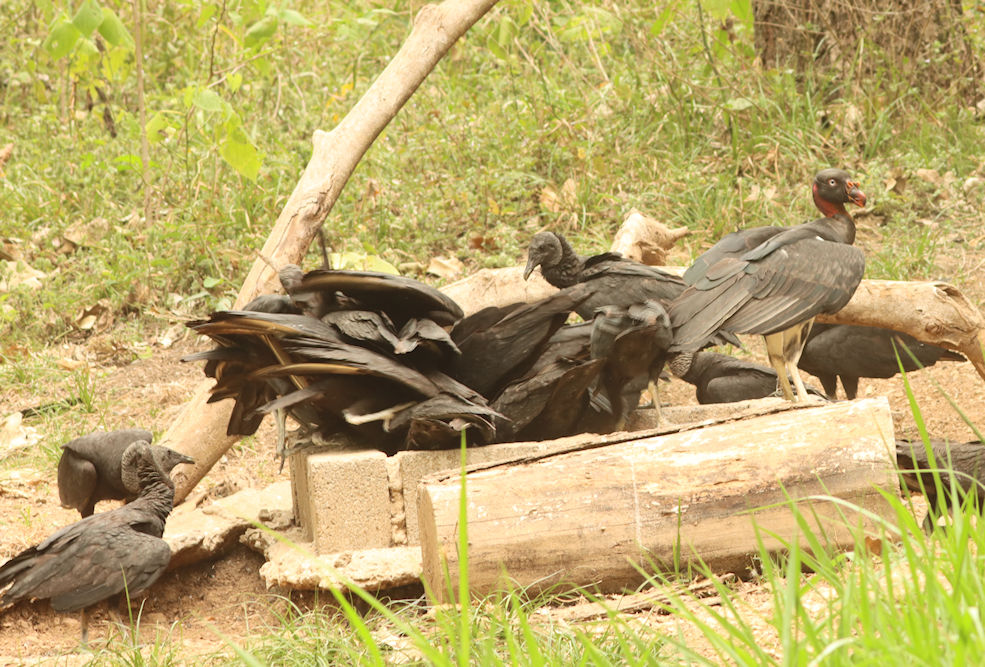
The baseline birdmass below us was, of course, a
veritable seething herd of Black Vultures. Though they kept a respectable
cleared space around the Kings whose beak I feared even at my distance.
Initially there was one adult King and a large dark juvenile that I immediately
assumed from size alone was also a King. Both birds towered above the Blacks.
The size difference in the books seemed poorly represented. Blacks being sturdy,
short-legged and thick-necked. Kings being none of that. The Blacks looked like
they could run beneath the lanky Kings without scraping their knobby heads on
the pure white King bellies. Normally the Blacks would be the bullies. But not
here. They are the vultures who can’t smell death, who must watch and follow the
crowds that form around death. Then they come and take. Kings disrupt this
agenda.
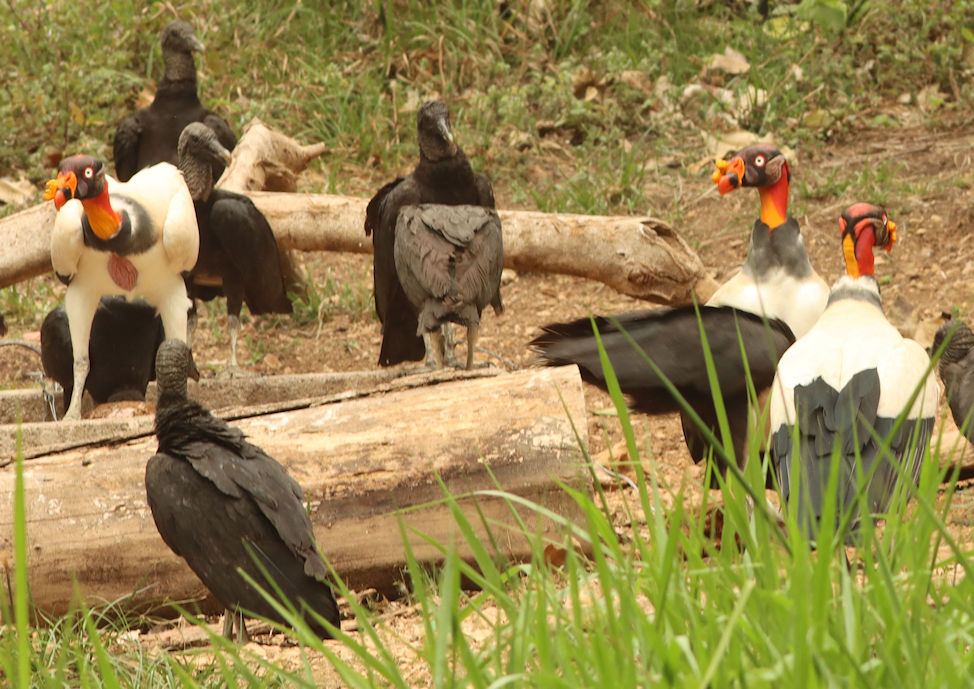
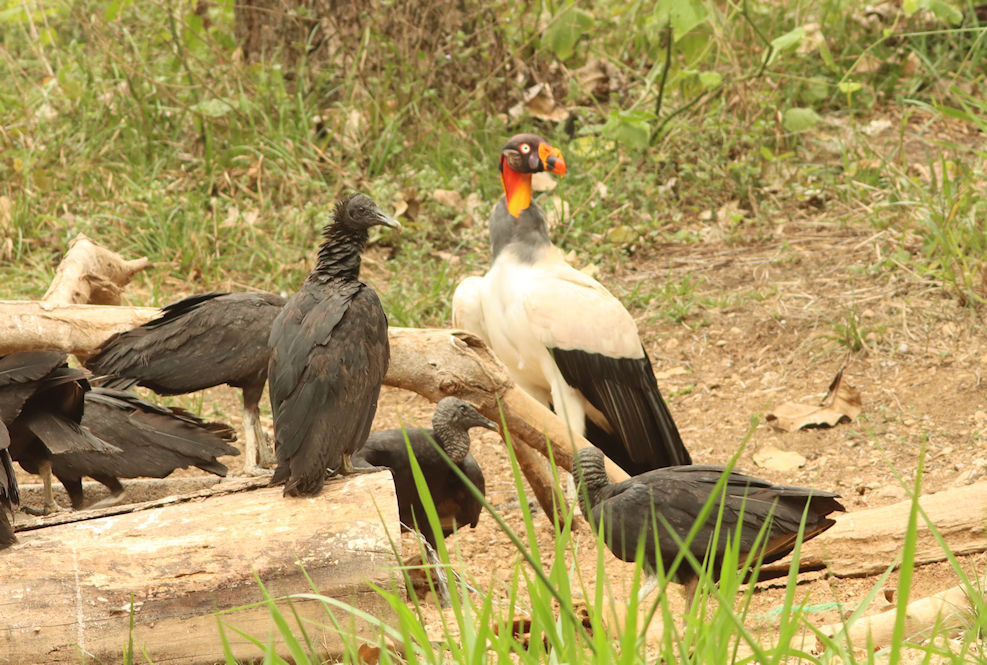
The adult King in his white and oranges and reds defies
easy description beyond color. And white is a real white in these things.
Nothing stalks or eats them so, hell yes, dress in some white. Evolution just
saying ‘whatever’ in this big vulture. Bring it on with your coding rules and
randomness. Even the eye is white, stark behind a red tipped beak that is black
at the base. The beak itself being overlapped by an orange fleshy prominence
like in the American Wild Turkey but bigger and meatier. The white eye is rimmed
in red and buried in a black mask for maximum accentuation. This blends into a
naked neck that is a fiery orange red. Its thin stalk jammed into a collar of
black at the base. The black ring touched up with some white and this all ringed
above the beautiful stark white of the shoulders, the long legs, the snowy
underbelly. On the back of the head is a patch of brighter orange which extends
in a defined stripe down the back of the neck. And the head is furrowed and
mapped into individual color areas. All featherless as in many carrion eaters.
It makes for a bizarre and beautiful bird head unlike any I have seen.
Eventually three different adults are feeding, and they
do appear to give some space to each other but not really. I think they
recognize the qualities of each other, exuding a ring of power. And they are not
known for their gregariousness overall. I’ve always thought I might like to be a
Peregrine Falcon, you know, in my next incarnation but, damn, these dressy
things. They take at least five years to reach all this magnificence. Kings in
captivity have lived 70 years. The third adult to arrive had the largest
profile, the largest fleshy chest prominence, the heaviest nosegay. Did I
mention this odd fleshy chest extrusion? I cannot word all the ways these things
are shaped. Even the great Harpy seemed monochrome and diminished comparatively.
Bo and I just kept glancing up from our cameras and shaking our heads.

The morning of our last full field day, Eli takes us to a
long zagging track through pastures and open fields while we ride atop the
viewing chairs in back. A Capped Heron soars over a field. A Crane Hawk unfurls
its black and white flag of a tail in an unnamable tree. It is a rough and
tumble road that brings us slowly to the hills where the preserve boundary lies.
We drive to a ranger station that looks abandoned, but Eli says it is sometimes
in use. Poaching happens in the reserve but there is often little to be done.
Who wants to punish them? A trail begins there below the quiet house. It is just
Bo and Anna and I with Eli now. And we take our time. The sunrise that struck
the hillside as we approached was memorable. And up the hill it is wet with
actual running water on stony creekbeds. Looking lush even in this dry season
time. More lush than anywhere we’ve been. And it feels quickly like we are
walking along a creek at home in the Ozarks. You know, one with not a single
plant I know. A Mourner whistles. We hear the low note of a Curassow somewhere
up the hill. A big turkey sized bird that is unfortunately delicious and doomed
in most places anywhere near human encroachment. Helicopter Damselflies signal
in white/black flutters while moving far too slowly for all that blading of the
still air. Like the camera of my eye has been set on slow motion. We gain
elevation and one tries to look out over some vista but we are sealed in by all
the greenery, the tall trees, the vines and flowers. The rocky creek hides Tiger
Herons and frogs. Bo and I would like to go and go up this watery wonder but
eventually we all have to come down.

On our final afternoon excursion, with just Bo and I and
Eli, Eli says he wants to go back down the road to the river village where the
Black Oropendolas are heard. We had seen a quick flyover earlier in the week.
But Eli really wanted us to see this bird. Oropendolas are sonically in a class
of their own. And the Black is a champion. It is a large Oro and it is
diminishing in number like many big jungle birds. It is mainly found here in the
east of Panama. Some sightings in Columbia but apparently not that common there.
It is a colonial nester in the large saclike woven nests like its close
relations. However, no one in Canopy currently knows where a nest group is
active. As usual, once on the gravel roadway we stop and start watching and
listening. At one stop we listen, and I see Eli’s face take on a truly impressed
look.
“You hear that?” he asks.
“The Great Crested Flycatcher?”
“No.” and he makes a hissing sizzle noise. “That one.”
I didn’t. But he says that only the Harpy and the Crested
Eagle make that sound. “I think this is a Crested.” We all listen. And Eli
clearly is battling over what to do. No one presently has a Crested nest
anywhere nearby. These big eagles wander and choose tall isolated trees like the
Harpy. Often big Cuipos. He decides to take the machete and whack his way
towards the sound. And we are pretty sure in his Canopy handbook one of the
rules is ‘Don’t venture into uncharted woods with the sometimes crazy and
reckless clients.’ We reassure him we are fine with waiting on the road and
listening while he gives it a shot. He says it may take a bit. We nod. And off
he goes. He asks us to make some noise when we hear him whacking back towards
us.
And we listen to the jungle calls. We watch a Trogon
fluttering and feeding. Some distant Howlers talk. As always, we watch for
insects. And we do hear the weird sizzle and think it is Eli after he is gone.
After a time, we hear him making his way. We whistle repeatedly but he comes out
exactly where he went in. No wandering. And he is actually sweating again. That
is twice now. He looks excited. He saw a large white Juvenile fly away and he is
convinced it was a young Crested. He will have some of his trusted locals whack
in there this next week and check for it again. He seems exhilarated. We are
happy for him. He regrets we did not see it. We are fine, we assure him. And we
head down towards the village and the river.
We stop before a long shaded treeline that leads directly
to the riverine village of the Emberas tribe. We leave the vehicle behind. It is
mid to late afternoon. Eli, constantly listening, pulls out his trusted phone
and speaker and begins to play the extraordinary sound of the Black Oropendola.
He thinks he has heard one distantly to the south. While we are listening, two
small boys wander up and keep a safe distance, though they are clearly watching
our activities. They are in shorts and t-shirts and barefooted. Looking about 8
and 5 years of age respectively. Eli greets them when they get closer, while he
continues to play the bird sounds. They tell him they have been in the river.
And it is ‘cool.’ I think meaning temperature and not otherwise cool. Their free
lives along this river must be far more adventurous than my own along the creek
at home many years ago. Though they do attend school. They clearly speak fluent
Spanish and Eli asks if they know Emberas, their native language. They shake
their heads. And tell him ‘only a bit from their parents.’ They do not teach the
native languages here. Both boys stare at the phone each time the Oro call
sounds. Perhaps their parents have cell phones. There appear to be a great many
satellite discs on the roofs of the village homes we have visited. I doubt they
had heard an iPhone making a Black Oro call before. And Eli asks if they know
the Oropendola. They appear to know the pale beaked one, the Crested, but even
they, living here along the river aren’t sure about the big black one.

Eli pulls the scope down lower and puts a far bird on the
wire in the scope for the two boys. Having, I doubt, never looked in a scope,
they pull one eyelid down with small fingers and peer in with the other eye. The
older boy looks back out at the bird and back in the scope. He seems astonished
that it is the same bird, far and near. Eli assures him. And then a large dark
bird flies over head and lands about twenty yards away in the low brush. It is
in the open. As he goes over, ‘that’s him’ Eli confirms. We binoculared
Americans scan the bird and I think we both gasped. It makes the Chestnut-headed
Oros look small. Eli puts it in the scope quickly and we fumble for some scope
shots before letting the boys have a look in the scope. Again, they are
impressed. The younger one up on tiptoes to look again holding his off-eye
closed. Eli asks if they know where any big Oro nest colonies are on the river
and they don’t know of any. And then the older boy looks all three of us over
carefully and asks Eli “Is this your work? Is this what you do?”
Eli answers that it is, indeed.
And the boy shakes his head and gives a big smile. “What
an amazing job!”
Eli translates and we all laugh and agree. It is far
better than any I may have had.
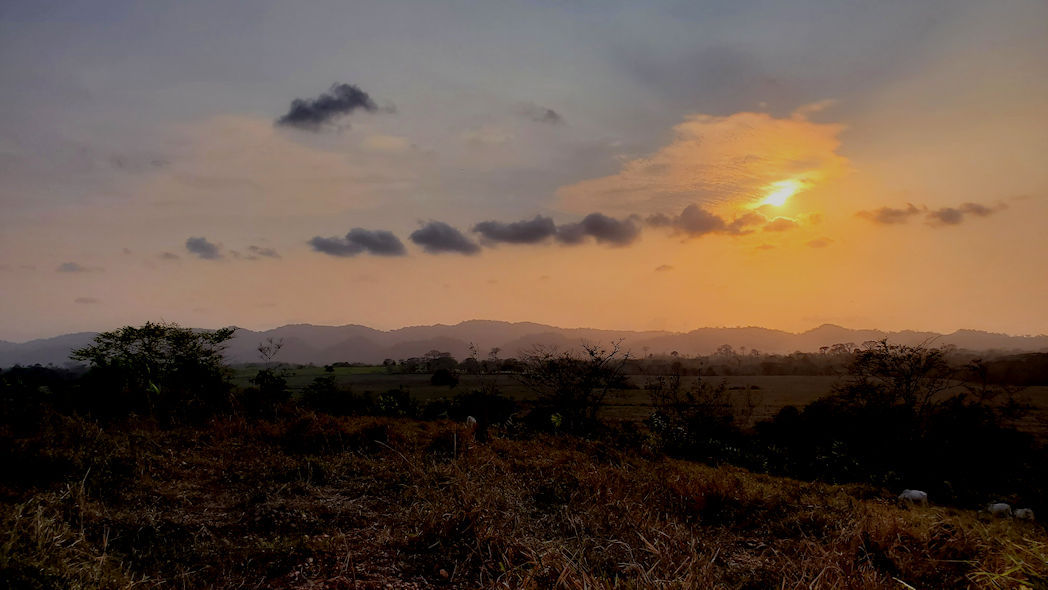
On our last night, we drag our zero gravity chairs over
on the deck to face what feels like west and southward. We are cocked back
looking above the tent toward some more open sky. Every star is out. You know
what I mean. There is almost no interfering light from a nearby town or village.
Orion sits to the slight left. I can see Leo off in the open as well. We have
rationed out our last scotch. We have turned out the tent light. It is just
silence and the occasional Tropical Screech Owl. Now and then the Mottled Owl
calls as well. Not our home birds but very nice nightbirds anyway. In the
mornings here when we are getting up in the dark the Great Potoo sometimes roars
his weird roar. No airline lights seem to be wandering across. Out there
somewhere over 15 billion miles away is Voyager 1, carrying the Howler Monkey
sounds to the waiting aliens. With Bach. One wonders what Bach would have
thought of Howler song? All the Voyager things of interest zooming farther every
day towards the dark edge of things. Here, there seems to be no human noise at
the moment. The world is all off away over there somewhere.
As we sit, Orion seems to bury itself slowly in the
zagged semi-darkness of the trees. Orion, of course being an earthbound
illusion. Those three nice belt stars are truly nowhere near each other. It is
all in our angle of acquisition. We are aligned. We have Orion to ourselves:
belt and sword, hunting imaginary beasts among the dark interstices where other
imaginary beasts reside. No other solar system has this specific hunter. And we
are the ones moving, not Orion, of course. At the lowest of the four speeds. The
speeds that mean we are never just being still despite my comfortable chair and
all this silence. We are carried on the surface of the earth at about 1000 miles
per hour. We ride around the sun in our turning at about 67,000 miles per hour.
We reel around our galactic center at 447,000 miles per hour. And our whole
galactic group tears towards the far nowhere at 1.3 million miles per hour. We
are always in a zigzag of great hurry, home or not, even here in the dark with a
comforting tang of some scotch that is older than my best cat. You can hold this
voodoo glass up to the dark sky. And after some Scottish magic you can suddenly
love humanity or you can love some selected individual people, like an
astonished barefoot boy on a far back road. It happens. It is a different form
of caring, sudden and real. You are thinking just now, under these bright stars,
that we are all together, and yet, sometimes, it still feels, a moment later,
like you are so very, very alone.
Thanks to Eli and the Canopy group again for showing us
their Panama.
Thanks to the Philly girls (Di, L, Lor and Barb) for
tolerating us.
Thanks to S and the Colonel for
showing us what father’s and daughter’s can do for each other.
“Si humiliare mi pueblo, sobre el cual mi nombre es
invocado, y oraren, y buscaren mi rostro, y se convirtieren de sus malos
caminos; entonces yo oire desde los cielos, y perdonare sus pecados, y sanare su
tierra.”
HR